
Transcript
Announcer:
You’re listening to GLC on ReachMD. This activity is provided by Global Learning Collaborativeand is part of our MinuteCE curriculum.
Prior to beginning the activity, please be sure to review the faculty and commercial support disclosure statements as well as the learning objectives.
Dr. Rubin:
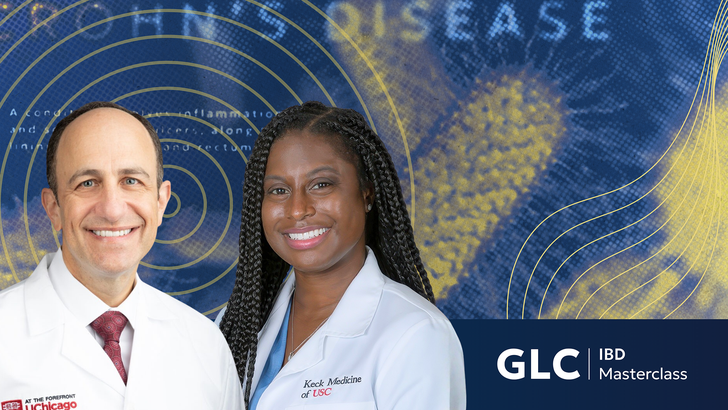
Hello, I'm Dr. David Rubin, and here with me today is Dr. Damie Odufalu. We're talking about small molecules for inflammatory bowel disease, and we have some exciting updates that we thought were worth sharing with you in a bite-sized message. So, Damie, why don't you share some of the updates?
Dr. Odufalu:
Hi, David. Thanks for introducing me. Yes, I wanted to discuss the expanding updates in small molecules because this is more of our newer class of therapies in IBD, and there's some great data out there to support its use earlier to get more targeted treatment and efficacy in our very severe patients.
So specifically, we can discuss our JAK inhibitors, upadacitinib. So there's been new exciting labeling where you no longer have to trial and fail an anti-TNF prior to starting. You can use this after any failed advanced therapy, and this generally will get approval from a patient's insurance. This is important because it aligns with our STRIDE-II guidelines with treat-to-target, and so I think it's great because it empowers us as providers to reach for this earlier for some of our more severely affected patients. And there's been some great phase 3 post hoc data looking at upadacitinib specifically in patients with perianal and fistulizing Crohn's disease. It shows that it is very effective versus no therapy, and it's a really good treatment for patients if you have been on a prior therapy as well.
And so I know that as a tertiary provider, sometimes I see that people are hesitant to reach for JAK inhibitors early, and over the years this has been something that I've used more and more for very severely active patients with Crohn's disease and with UC.
Dr. Rubin:
Yeah, I really appreciate you bringing these up. The FDA loosening or updating the label on upadacitinib I think was a really important message to our colleagues that the long-term follow-up and the safety profile of this therapy in our patients with inflammatory bowel disease was worthy of allowing us to make decisions as their primary clinicians rather than being forced to use anti-TNFs first. We were the only country that had that regulatory requirement.
So for upa, being able to choose a patient who might benefit from it rather than going through other lines of therapy first is really important. For me personally, it will be my go-to therapy in patients who have inflammatory arthropathies with their IBD. It's my definite go-to therapy if I have a patient with colitis who has a low serum albumin, as you highlighted in one of our prior discussions. And I love the idea of having something else to offer patients who have perianal fistulizing disease, so I'm really grateful that you brought it up.
My only other comment is that I've started recommending that we not even use corticosteroids anymore. So if you know you're going to go to upa or tofacitinib, they work so quickly that I don't think using steroids is necessary once you get the drug for the patient. They shouldn't have to be on another agent that's going to confuse their side-effect profile or immune suppress them in any other way. So I go directly to the drug, and I avoid steroids.
Dr. Odufalu:
Yeah, wow. Thanks for sharing that. That's also something I'm doing in my practice. It's less of a pill burden, less side effects, specifically the anxiety, sleep, blood glucose. So it's really great that we have a quick steroid-sparing agent.
Dr. Rubin:
Yeah. Do you have any updates on the S1Ps? Are you using them more often in your practice or any pearls you might share?
Dr. Odufalu:
So, I'm definitely using S1Ps, both etrasimod and ozanimod, in my patients with more moderate UC or patients who are not quite responding completely to the 5-ASAs. It sounds like there is some research coming in the pipeline looking at S1Ps in patients who have some inflammation in the pouch, but more to be determined later.
Dr. Rubin:
Yeah, I think that these are underutilized in general, so it's good to see people starting to adopt them and to study them in different settings. Completely agree that the emerging, mostly post hoc analyses, but I think in our real-world experience as well, it's better for the people with moderate disease, and that certainly might include someone who has pouchitis which is sort of a variant of ulcerative colitis and someone who's had a colectomy with a J-pouch.
So there's some unique things for us to think about and certainly more options for our patients.
So I really appreciate you sharing these insights, and I'm hopeful that it's helpful for our colleagues. And this has been a great bite-sized discussion. Our time is up. Thanks for listening.
Announcer:
You have been listening to GLC on ReachMD. This activity is provided byGlobal Learning Collaborativeand is part of our MinuteCE curriculum.
To receive your free CE credit, or to download this activity, go to ReachMD.com/CME. Thank you for listening.

 Global Learning Collaborative (GLC) designates this activity for 2.0 contact hour(s)/0.2 CEUs of pharmacy contact hour(s).
  Global Learning Collaborative (GLC) has been authorized by the American Academy of PAs (AAPA) to award AAPA Category 1 CME credit(s) for activities planned in accordance with AAPA CME Criteria. This activity is designated for 2.0 AAPA Category 1 CME credit(s). Approval is valid until 6/1/27. PAs should claim only the credit commensurate with the extent of their participation in the activity.

